De
De
 En
En
Research collaboration between SanaBio and Anhalt University of Applied Sciences
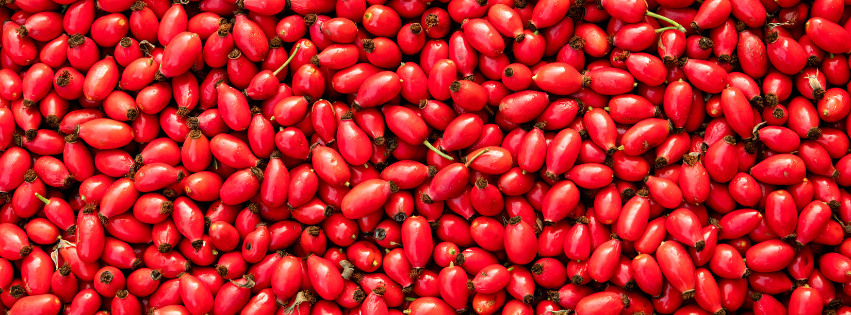
Rosehips are widely known for their bright red fruits and their use in teas, jams, and juices. However, an important part of the fruit has long remained underutilized: the press cake that remains after processing rosehips for juice or oil production.
A research collaboration between SanaBio GmbH and Anhalt University of Applied Sciences (Hochschule Anhalt) in Bernburg is investigating how this by-product can be converted into a valuable food ingredient.
The project focuses on rosehip press cake (“Hagebuttentrester”), a material that is produced in large quantities during the industrial processing of rosehips. In Germany alone, more than 20,000 tons of rosehip press cake are produced annually.
Rather than remaining an underused by-product, this material contains a range of nutrients that make it a promising candidate for food applications.
Nutritional potential of rosehip press cake
Analyses conducted within the research project show that rosehip press cake contains several nutritionally relevant components, including:
• soluble and insoluble dietary fiber
• protein
• low sodium levels
• vitamins, including B vitamins, vitamin C, and vitamin E
This composition makes rosehip press cake particularly interesting in the context of modern diets. Many current eating patterns contain excessive amounts of fat and sugar, while the intake of fiber and certain micronutrients is often too low. Ingredients naturally rich in dietary fiber, therefore, offer significant potential for improving the nutritional profile of foods.
Because of these properties, SanaBio initiated cooperation with the research group led by Prof. Dr. Wolfram Schnäckel at Anhalt University of Applied Sciences. The goal of the collaboration is to investigate how rosehip press cake can be processed and integrated into different food products.
Processing Challenges: From Press Cake to Food Ingredient
Before rosehip press cake can be used in food products, it must first be processed into a suitable flour. One of the central technological challenges identified by the research team was particle size.
For many food applications, particles must be smaller than 75 micrometers to avoid negative effects on texture, mouthfeel, and product structure.
Achieving such fine particle sizes proved technically demanding. Researchers tested several milling systems, including:
• roller mills
• hammer mills
• cutting mills
• ball mills
During processing, another difficulty emerged: very fine particles tended to agglomerate during sieving, which made it harder to separate the desired particle fractions.
Using microscopic analysis and process optimization, the researchers were able to identify suitable milling parameters. As a result, approximately 45% of the material could be obtained as a fine fraction that is suitable for use in food products.
The remaining coarser fraction can still be used in other applications, such as cosmetic formulations. This fractionation approach allows the entire raw material stream to be utilized efficiently.
Applications for Meat Products
One of the first application areas investigated was the production of sausage products.
When rosehip press cake flour was added to cooked sausage formulations, researchers observed an increase in flavor intensity. This enabled a reduction in the use of salt and color additives in the product.
However, the addition also caused a slight greyish coloration in the sausage. This effect can be compensated for by processing the flour in suspension or by combining it with natural color sources such as beetroot powder.
Technologically, the ingredient also influenced yield and processing efficiency:
• In cooked sausages, the addition of 4.5% rosehip press cake flour increased product yield by approximately 10%.
• In raw sausages, the same addition shortened the ripening time and increased yield by around 4%.
These effects could potentially lead to economic advantages for manufacturers, such as higher production capacity and improved resource efficiency.
Applications in dairy products and desserts
The research team also tested rosehip press cake flour in dairy products and dessert applications.
Some products proved less suitable. For example, when the flour was added to yogurt, the mixture tended to separate into phases, and the taste developed an astringent note, which reduced consumer acceptance.
In other products, however, the results were more promising.
Pudding
When part of the starch in pudding formulations was replaced with rosehip press cake flour, the product developed a more aromatic, slightly nutty flavor.
Researchers found that replacing about one-third of the corn starch with rosehip flour produced acceptable results. Higher amounts led to undesirable sensory effects, including a dry and sandy texture.
Quark desserts
In quark-based desserts, additions of up to 4.5% were possible without affecting product quality.
Ice cream
Ice cream formulations containing 5–6% rosehip kernel flour achieved positive sensory evaluations in tasting panels.
Chocolate Products
Rosehip press cake flour was also tested in chocolate and pralines, where additions of up to 6% were possible.
Applications for baked goods
Among all tested product groups, bakery products showed the widest application potential.
In products such as short crust cookies, sponge cakes, wheat rolls, and muffins.
Rosehip press cake flour could be incorporated at levels of 3–6% without negatively affecting taste or texture.
In crispbread, even higher additions were possible. Due to the naturally dry and crunchy structure of this product category, up to 15% rosehip press cake flour could be used successfully.
Rosehip press cake flour: fiber content and EU Regulation
One important finding of the research project relates to regulatory nutrition claims.
Even products containing 3% rosehip press cake flour can meet the criteria of EU Regulation (EC) No. 1924/2006 to be labeled as a “source of dietary fiber.”
This opens opportunities for food manufacturers to develop products with improved nutritional profiles while using a natural plant-based ingredient.
From a by-product to a valuable ingredient
The research conducted at Anhalt University of Applied Sciences in cooperation with SanaBio demonstrates how a by-product can be transformed into a functional food ingredient.
Rosehip press cake, once largely overlooked, contains valuable nutrients and functional components that can contribute to the development of fiber-rich foods.
The project illustrates how innovative processing approaches can support the more efficient use of plant-based raw materials in the food industry.
Ongoing development of new applications
Beyond the initial product trials, the research collaboration continues to explore further applications.
Current development work includes recipes and prototypes for mixed breads, vegetarian and vegan sausages, smoothies, fish products, sauces, and spreads.
The aim is to evaluate both technological feasibility and consumer acceptance across a wide range of food categories.